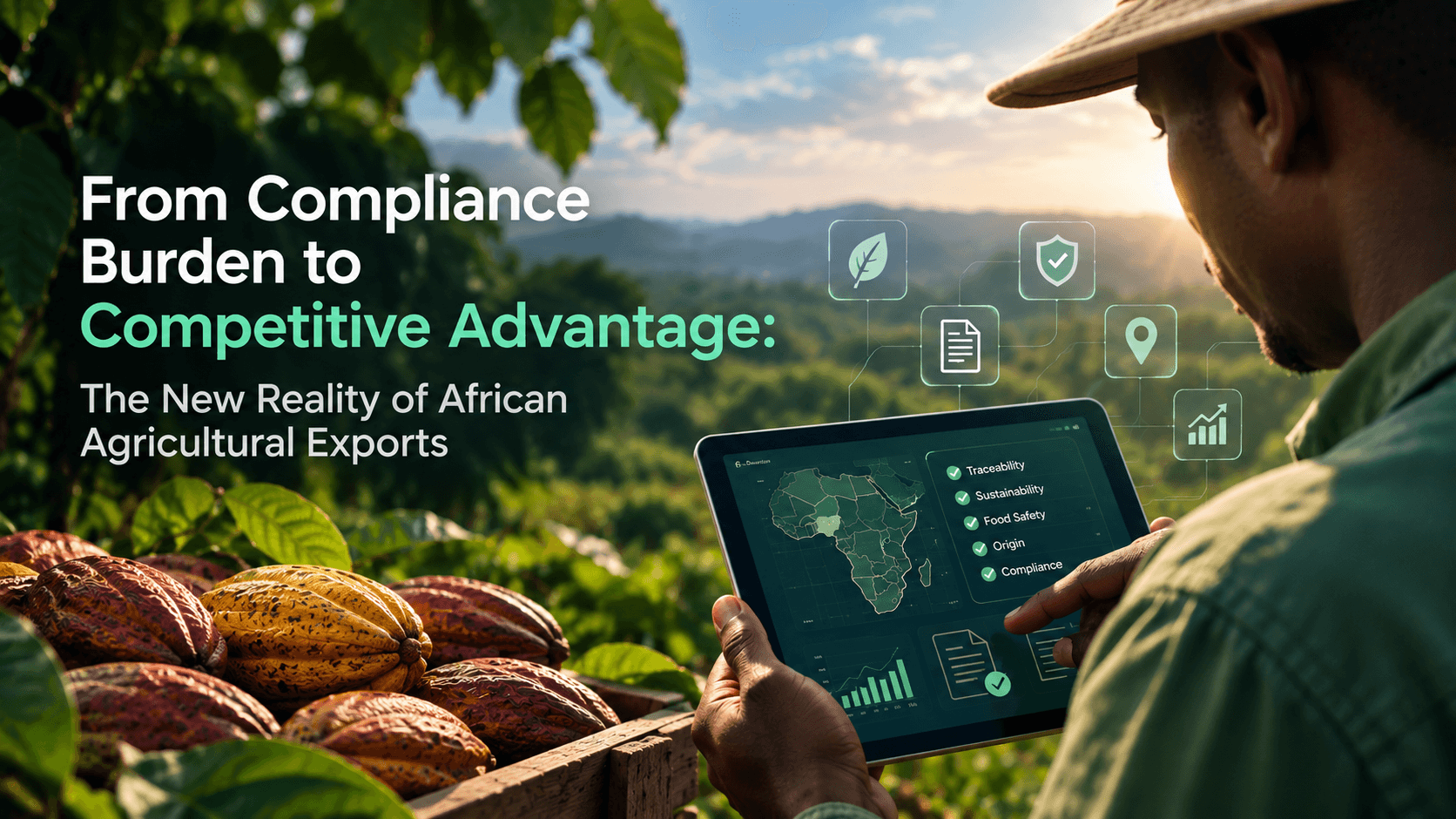
We Have the Data. Can We Really Trust It?
Agricultural supply chains are collecting more data than ever: producers, plots, GPS coordinates, certifications, lots, audits and compliance documents. Yet more data does not automatically mean better traceability. Recent work by Fairtrade highlights a growing challenge: making data connected, reliable and genuinely useful to the people who need to act on it.
In cocoa, coffee and other agricultural supply chains, traceability has become an essential part of doing business.
Companies now collect information on producers, plots, geolocation, volumes, lots, certifications and different stages of the supply chain.
At the same time, requirements from programmes such as Fairtrade, Rainforest Alliance and, increasingly, the EUDR are adding new layers of information and verification.
On paper, this should create increasingly transparent supply chains.
But there is a bigger question:
Does more data necessarily mean better traceability?
Not always.
The challenge is not only collecting data
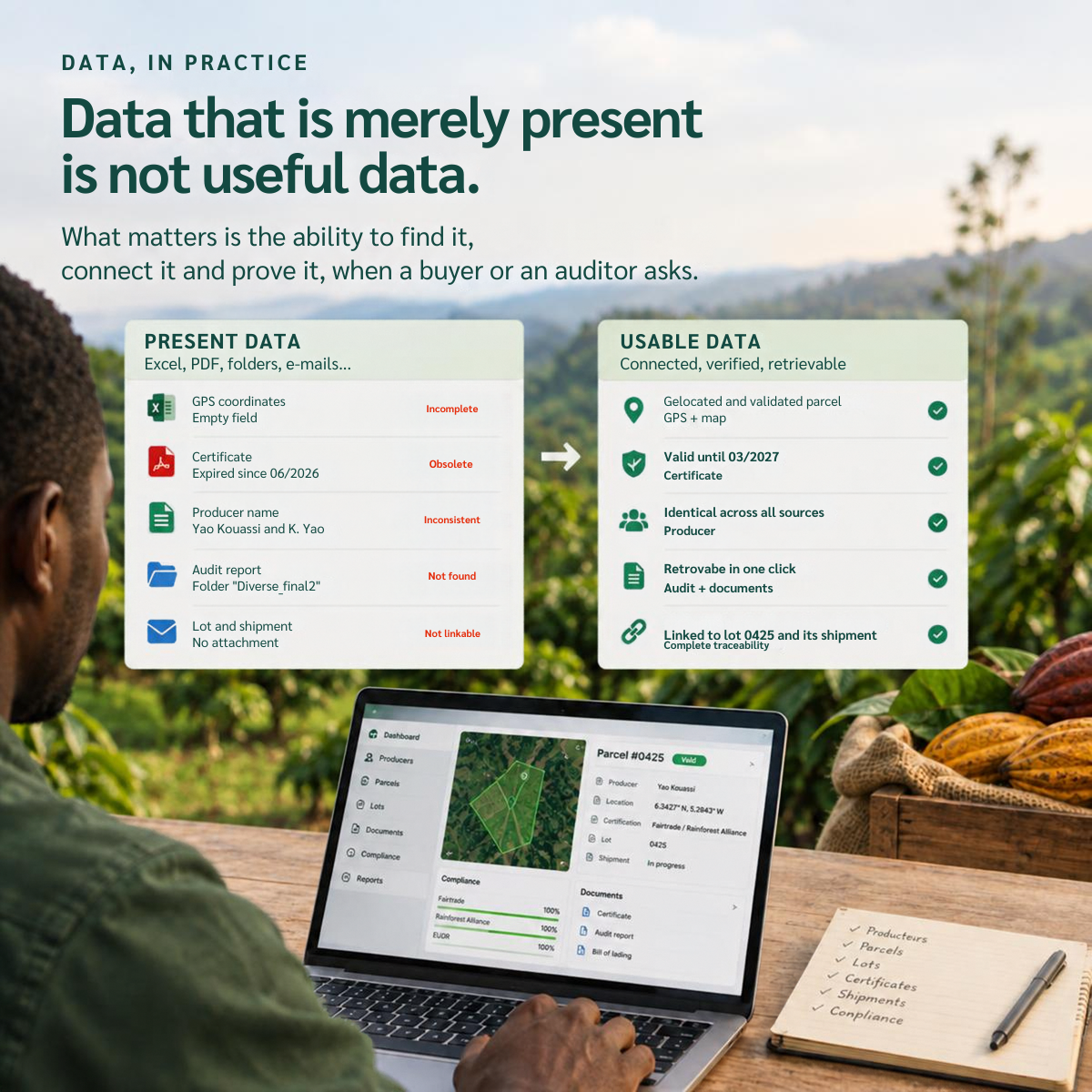
In many organisations, the information already exists. A producer list may be stored in Excel. GPS coordinates in another file. Certificates in PDFs. Audit reports in separate folders. Lot information in another system. And supplier communication across email or WhatsApp.
Each piece of information may be useful on its own. The challenge appears when you need to connect them.
A producer needs to be linked to a plot. A plot to a lot. A lot to a shipment. Documents need to correspond to the right entities. And information from different sources needs to tell the same story.
At that point, traceability becomes less a data collection problem and more a problem of data connection and verification.
Fairtrade highlights a broader challenge
In its recent work on trusted traceability, Fairtrade highlights the importance of systems being able to work better together, without necessarily forcing organisations to abandon the tools they already use.
The objective is not simply to move more data around. It is to allow different actors to reuse, connect and understand the information they already have.
This is particularly relevant in agricultural supply chains where several systems already coexist: certification, traceability, supplier management, geolocation, audits and regulatory requirements.
Interoperability can therefore help reduce fragmentation and duplication, while improving confidence in the data itself.
Available data is not necessarily usable data
This may be one of the most important distinctions to make.
An organisation can have thousands of data points and hundreds of documents without having a clear picture of its actual situation.
Data can exist without being usable.
Information can be incomplete, outdated, inconsistent with another source, difficult to retrieve, difficult to link to the right producer, plot or lot.
In these situations, compliance teams still spend significant time searching, comparing and manually verifying information.
The work is necessary. But much of it is also repetitive and time-consuming.
Trust starts with data quality
Trusted traceability is therefore not only a technology issue. It is also about how data is created and used.
Who collected the data?
How was it verified?
Who can access it?
Can it be connected to another source?
Can its origin be understood?
Can it support an actual decision?
These questions become increasingly important when the same information needs to serve multiple purposes: certification, regulatory compliance, customer requirements, internal reporting or audit preparation.
Data quality becomes a condition for decision quality.
The next challenge: making data work together
The evolution of traceability should not necessarily mean adding more platforms.
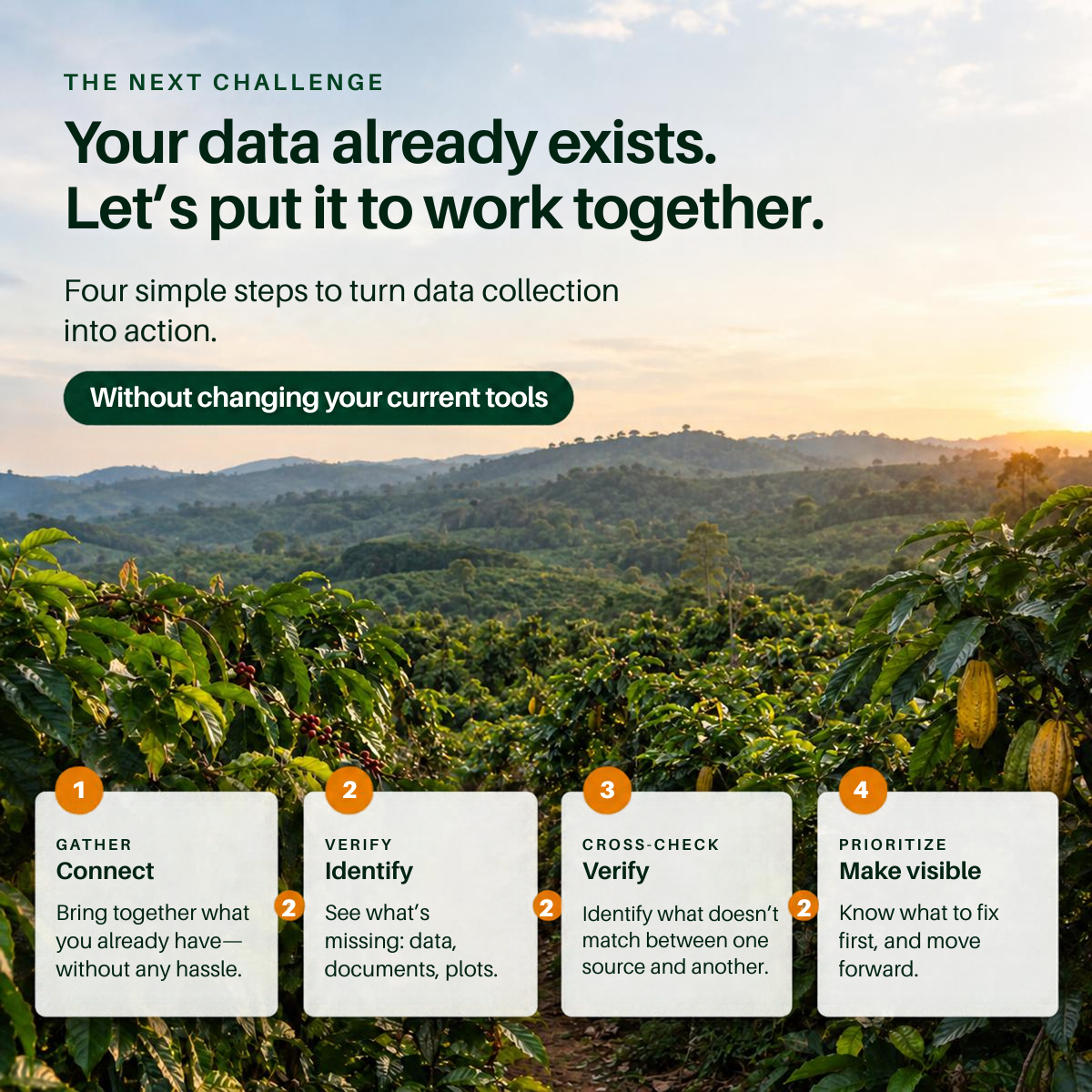
In many cases, the priority may be much simpler:
connect what already exists;
identify what is missing;
verify what does not match;
and make information understandable to the people who need to act.
This is where digital tools can create new value. Not necessarily by replacing existing systems, but by adding a layer that helps teams make better use of their data, faster.
From data collection to operational intelligence
The next stage of traceability may therefore be less about:
“How much data do we have?”
and more about:
“What can we confidently understand and act on from the data we have?”
For agricultural exporters and organisations across Africa, this distinction matters.
The goal is not to collect data simply to fill more spreadsheets. It is to build supply chains where information can be connected, verified and used with confidence.
The traceability systems of tomorrow may not be defined by how much data they collect, but by how effectively their users can connect that data, verify its quality and act on it.
That is where the traceability that can trusted begins.
Regulatory information may change over time. This content is provided for informational purposes and should not be considered legal advice.